

 Services ›
  Gifts, Sports & Toys ›
  Machinery, Industrial Parts & Tools ›
  Transportation ›
  Mineral, Textile, Herbal and Animal Products ›
  Agriculture & Food ›
  Health & Beauty ›
  Oil, Gas, Chemical, Rubber and Plastics ›
  Electric, Electronics and Telecommunications ›
  Apparel,Textiles & Accessories ›
  Packaging, Advertising & Office ›
  Home, Lights & Construction ›
 Services Browse all products ›
Mining & Oil & Gas Services 7 active subcategories Building & Construction & Maintenance Services 2 active subcategories Industrial Production & Manufacturing Services 9 active subcategories Industrial Cleaning Services 4 active subcategories Environmental Services 4 active subcategories Transportation & Storage & Mail Services 6 active subcategories Management & Business Professionals & Administrative Services 7 active subcategories Engineering & Research & Technology Based Services 7 active subcategories Editorial & Design & Graphic & Fine Art Services 6 active subcategories Public Utilities & Public Sector Related Services 3 active subcategories Financial & Insurance Services 5 active subcategories Healthcare Services 7 active subcategories Education & Training Services 5 active subcategories Travel & Food & Lodging & Entertainment Services 6 active subcategories Personal & Domestic Services 2 active subcategories National Defense & Public Order & Security & Safety Services 1 active subcategories Politics & Civic Affairs Services 4 active subcategories Organizations & Clubs 3 active subcategories Gifts, Sports & Toys Browse all products ›
Machinery, Industrial Parts & Tools Browse all products ›
Mining & Well Drilling Machinery & Accessories 5 active subcategories Farming & Fishing & Forestry & Wildlife Machinery & Accessories 2 active subcategories Building & Construction Machinery & Accessories 1 active subcategories Industrial Manufacturing & Processing Machinery & Accessories 19 active subcategories Material Handling & Conditioning & Storage Machinery & their Accessories & Supplies 5 active subcategories Power Generation & Distribution Machinery & Accessories 5 active subcategories Tools & General Machinery 4 active subcategories Structures & Building & Construction & Manufacturing Components & Supplies 14 active subcategories Manufacturing Components & Supplies 29 active subcategories Distribution & Conditioning Systems & Equipment & Components 4 active subcategories Laboratory & Measuring & Observing & Testing Equipment 3 active subcategories Cleaning Equipment & Supplies 4 active subcategories Service Industry Machinery & Equipment & Supplies 2 active subcategories Transportation Browse all products ›
Mineral, Textile, Herbal and Animal Products Browse all products ›
Agriculture & Food Browse all products ›
Health & Beauty Browse all products ›
Oil, Gas, Chemical, Rubber and Plastics Browse all products ›
Electric, Electronics and Telecommunications Browse all products ›
Electronic Components & Supplies 6 active subcategories Electrical systems & Lighting & components & accessories & supplies 4 active subcategories Information Technology Broadcasting & Telecommunications 5 active subcategories Defense & Law Enforcement & Security & Safety Equipment & Supplies 5 active subcategories Apparel,Textiles & Accessories Browse all products ›
Packaging, Advertising & Office Browse all products ›
Orbita+, LLC
✓✓ Verified supplier ★ Gold member
◇3Active products
♙1Contact people
▤0Approved documents
☆PremiumMembership
Products (3)
Explore this supplier's active products.


About the company
Company introduction and official registration information.
Orbita+, LLC (founded in 2010) were established to conduct research and development work on the creation of robotic rehabilitation complexes for people with disabilities due to:
stroke, cerebral palsy, traumatic brain or spinal cord injury, diseases of the nervous system and other diseases that have impaired the patient's motor abilities.
The prototype and serial samples have an author's design and patent protection.
The work began with cooperation with the Pavlov Institute of Physiology of the Russian Academy of Sciences, Leningrad Region. Under the guidance of Doctor of Biological Sciences, Professor, Head of the Laboratory of Physiology of Movement at the Pavlov Institute of Physiology of the Russian Academy of Sciences, Corresponding Member of the Russian Academy of Sciences Gerasimenko Yu.P., a system of methods for influencing the spinal cord has been developed to restore the motor activity of spinal patients. The treatment is based on electrical stimulation of the spinal cord in combination with the forced evocation of walking movements.
From personal experience, we had to make sure that there are very few domestic rehabilitation systems for people with disabilities. We have manufactured a number of devices that are already used in many rehabilitation centers.
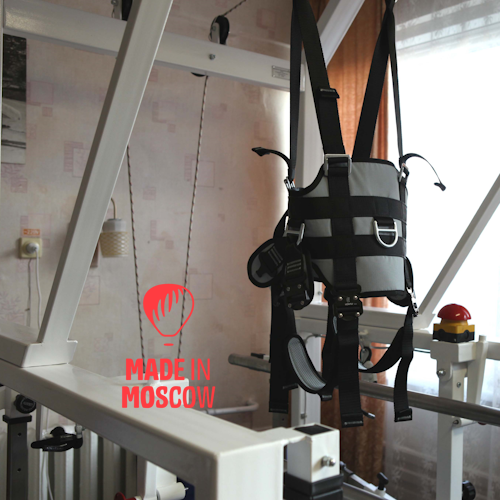
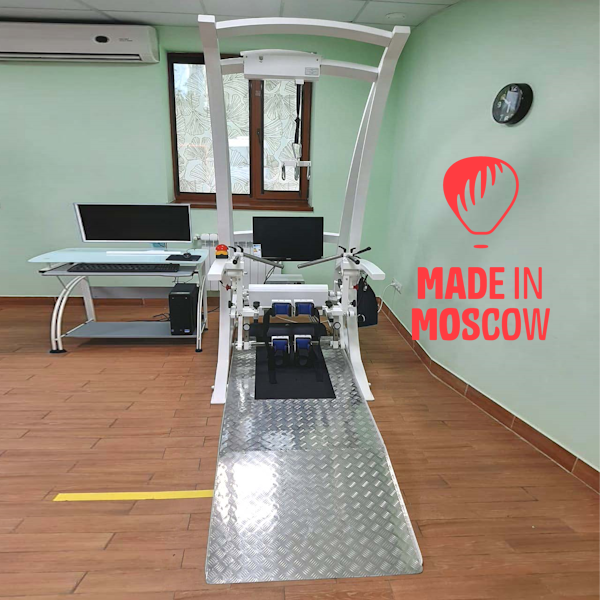
The specialists of our organization have created a sample device that provides forced walking movements. It is registered under the name "System for locomotor therapy of CPT". This robotic complex has been successfully used in the treatment process since 2012.
The system for locomotor therapy in the specialized department has been used since October 2018.
Patients with spinal cord injury and spinal cord injury at various levels underwent the restoration of lost walking skills.
During the 2.5 years of operation of the system for locomotor therapy in the period from October 2018 to June 2021, about 95 patients underwent rehabilitation. Of these:
39 patients with lumbar spine injury;
32 patients with thoracic spine injury;
17 patients with cervical spine injury;
5 patients diagnosed with: Cerebral palsy (cerebral palsy);
2 patients diagnosed with Multiple sclerosis, spastic form.
CPT was prescribed in the amount of 10 procedures in combination with physical therapy and mechanical exercises.
By reducing the threshold of spasticity on CPT, it is possible to rehabilitate patients with spasticity up to 3-4 Ashfort scores. The spasticity of the muscles of the lower extremities is significantly reduced to 2-1 Ashfort scores, which allows the patient to control voluntary movements in the lower extremities.
The use of CPT also prevents the formation of contractures of the knee and ankle joints in paraplegia of the lower extremities due to the active work of the periarticular muscles.
▣Registered on Ecasb28 Aug 2025
⌂EstablishedSep 9 201
▤Registration no.1107746735733
⌖CountryRussia
Documents & catalogs (0)
Approved catalogs, certificates and company documents.
No approved documents are available.
Company contact
Official contact channels, address and location.
⌖Address20 Petrovsko-Razumovskaya lane., apt. 6, Moscow ◎Websitehttps://orbita-rt.ru/slt
♙
Sign in to securely view the supplier's phone number and email.
Sign in to view contact detailsPeople (1)
Official company contact people.
Direct message